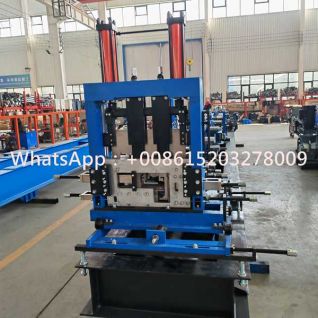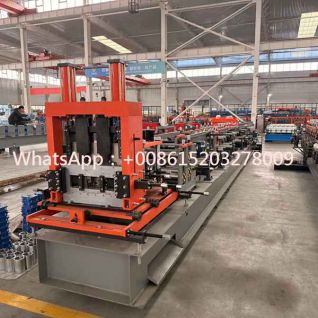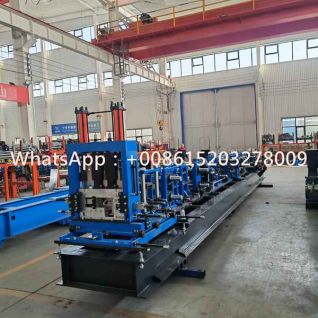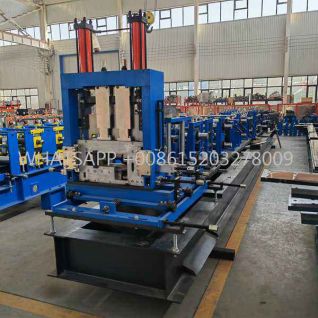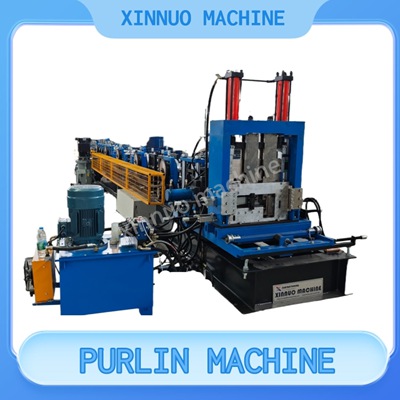
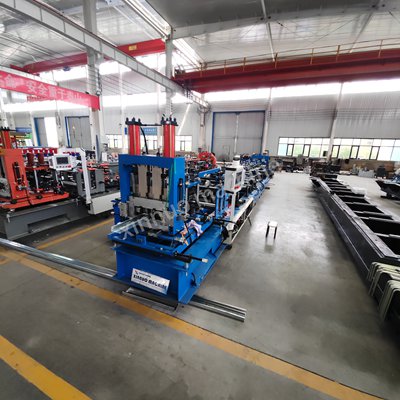
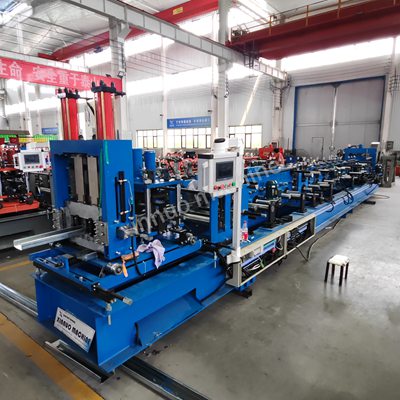
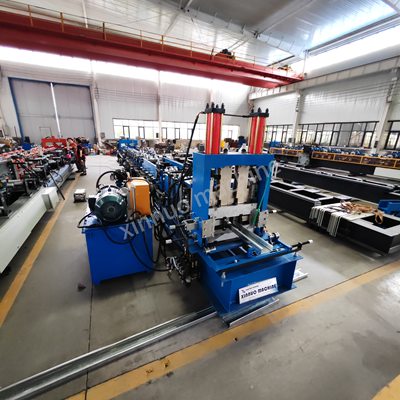
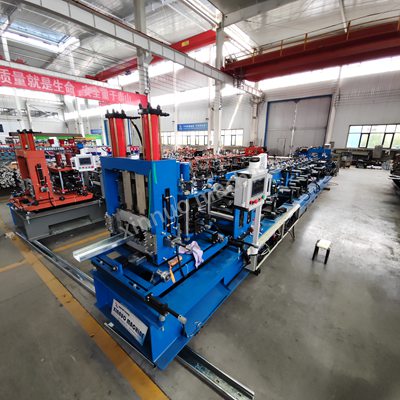
Under frame 400 mm H Steel
Roller material Cr12
Shaft diameter 85mm
Transfer method 2 inch chain drive
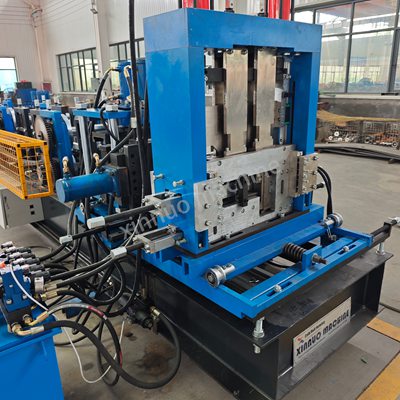
Structure "Independent cast iron archway.
more stable and very strong."
Main motor power Hydraulic motor
Cutter material Cr12Mov
The purlin roll former is designed for continuous manufacturing of steel purlins widely used in modern construction and structural framing systems. It ensures stable forming accuracy, high efficiency output, and reliable industrial performance for large-scale production environments.
The machine enables uninterrupted forming of steel coils into purlin profiles, ensuring stable speed control and consistent output quality for industrial manufacturing.
The system supports quick adjustment of different purlin dimensions, allowing multiple specifications to be produced without complex roller replacement.
The frame is built with heavy-duty welded steel, ensuring long-term stability during continuous high-load operation and reducing vibration impact.
High-quality rollers ensure accurate shaping of steel strips into consistent purlin profiles, maintaining dimensional accuracy throughout production cycles.
The hydraulic cutting unit provides smooth and precise cutting results, ensuring clean edges and reducing secondary processing requirements.
| Item | Description |
|---|---|
| Material Type | Galvanized Steel / Cold Rolled Steel |
| Profile Type | C / Z / U Purlin Optional |
| Thickness Range | 1.5 – 3.5 mm |
| Production Speed | 10 – 22 m/min |
| Roller Stations | 12 – 20 stations |
| Control System | PLC Automatic Control |
| Cutting System | Hydraulic Servo Cutting |
| Adjustment Mode | Manual / Automatic Adjustment |
| Shaft Material | 45# High Strength Steel |
| Frame Structure | Heavy Duty Welded Frame |
| Voltage | 380V / 50Hz / 3 Phase |
Steel Coil Loading → Decoiler → Leveling System → Punching Unit → Roll Forming Section → Length Measurement → Hydraulic Cutting → Output Table
A purlin roll forming machine is a sophisticated automated equipment engineered specifically for cold roll forming processes, playing a pivotal role in the production of structural purlins used in steel-framed buildings. Its primary function is to transform flat metal sheets—including galvanized steel, color-coated steel, and cold-rolled steel—into purlins with precise cross-sectional shapes such as C, Z, and U profiles through a series of continuous rolling operations. This machinery is indispensable in modern construction, providing the critical support structures for roofs and walls in industrial plants, warehouses, stadiums, and commercial buildings.
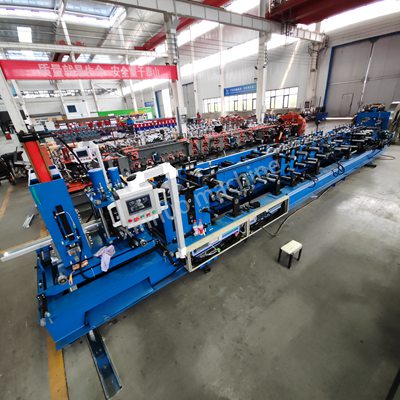
The core working principle relies on cold forming technology, which eliminates the need for preheating the metal material. Instead, the machine uses 15-25 sets of sequentially arranged rollers, each designed to incrementally bend the sheet to a specific angle or curvature. This gradual deformation process preserves the material’s mechanical properties, avoiding the structural weaknesses that can result from high-temperature processing. The entire production cycle is fully automated, from the initial uncoiling of the metal coil—secured by a hydraulic tensioning decoiler—to guided feeding, roll forming, precise cutting, and final stacking of finished purlins. A PLC control system with a user-friendly touchscreen interface oversees operations, allowing operators to set parameters like length, thickness, and production speed with ease.
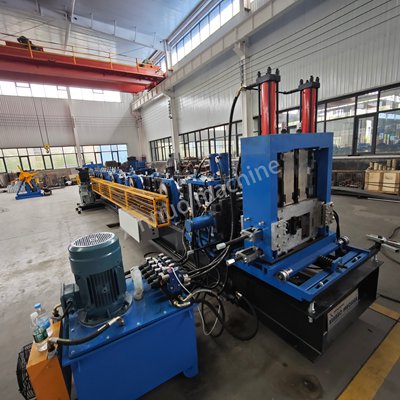
Key components of the machine include a guiding device equipped with correction wheels and limit plates, which dynamically adjusts the sheet’s position to prevent misalignment during forming. The forming rollers, crafted from high-strength alloy steel and hardened to HRC55 or higher, ensure long-term durability and shape retention under continuous operation. For cutting, a hydraulic flying saw system synchronizes with the sheet’s movement, delivering burr-free cuts with length tolerances within ±1mm without interrupting the production flow.
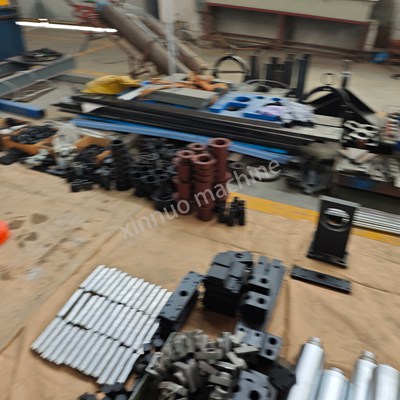
This equipment offers numerous advantages: energy efficiency, consuming 60% less energy than hot rolling processes; high precision, with cross-sectional dimensional errors controlled within ±0.5mm and straightness within 1mm/m; and exceptional material utilization exceeding 95%, minimizing waste compared to traditional stamping methods. Its flexibility is another standout feature—by replacing modular roller sets (a process taking just 30-60 minutes), it can process sheets 0.8-3mm thick and 100-300mm wide, producing purlins 1-12 meters long to meet diverse construction needs.
Widely adopted across the steel structure industry, purlin roll forming machines drive the development of lightweight, modular, and green building practices, solidifying their status as essential tools in modern construction manufacturing.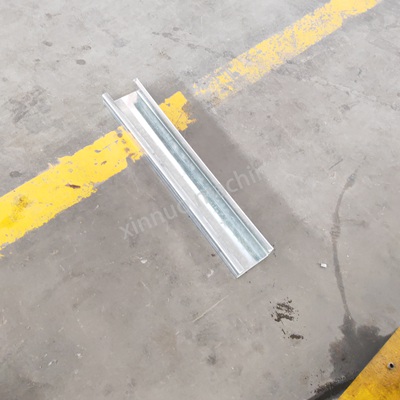
Xinnuo Roll Forming Machine Co., Ltd., established in 1995, is a leading enterprise specializing in the design, development, manufacturing, and sales of various cold roll forming equipment.
Located in Botou Economic Development Zone, the company benefits from a well-developed electromechanical manufacturing industry and a complete industrial chain...[ Read More >>]